Annotated Bibliography Example for Students (APA & MLA)

An annotated bibliography is a list of citations, each followed by a brief evaluative paragraph. Here are two ready-to-copy entries you can model right now.
APA (7th edition) — Journal Article
Goldschneider, F. K., Waite, L. J., & Witsberger, C. (1986). Nonfamily living and the erosion of traditional family orientations among young adults. American Sociological Review, 51, 541–554.
The authors, researchers at the Rand Corporation and Brown University, draw on data from the National Longitudinal Surveys of Young Women and Young Men to test whether living outside the family home shifts young adults’ attitudes toward traditional sex roles. They find strong support for this hypothesis among young women, with fewer effects among young men. The study is methodologically rigorous and uses a nationally representative dataset, lending it high credibility. One limitation is its age; attitudes toward gender roles have shifted considerably since 1986. For a paper examining how living arrangements shape social values, this source provides foundational quantitative evidence and a useful counterpoint to more recent studies.
MLA (9th edition) — Book
Howard, Ted, and Jeremy Rifkin. Who Should Play God? Dell, 1977.
Howard and Rifkin survey the landscape of genetic engineering research, focusing on who conducts the experiments and who profits from them. The book takes a clear anti-genetic-engineering stance, which the authors signal through chapter titles like “Eugenics” and “Bio-Futures.” While the ideological position limits its use as a neutral source, it is valuable for representing left-leaning political arguments against biotechnology. A researcher writing about the ethics of genetic science would find this book most useful for mapping the social and political opposition that emerged in the 1970s.
What each annotation contains:
- Summary: One to three sentences on the source’s main argument, methods, and findings — in your own words, no quotes.
- Assessment: One to two sentences evaluating the author’s credentials, the source’s credibility, and any notable limitations.
- Reflection: One to two sentences explaining how you plan to use the source in your own project.
Pro Tip: Most instructors expect annotations about 150 words. Before you write a single entry, ask your instructor whether they want descriptive, evaluative, or combination annotations — the answer changes everything about what you write.
Table of Contents
- What is an annotated bibliography, and why do instructors assign it?
- Annotated bibliography examples across source types and styles
- How do APA and MLA formatting rules actually differ?
- How to write an annotation step by step
- Sample annotated bibliographies: APA and MLA mini-examples
- Common mistakes and how to fix them before you submit
- Key Takeaways
- The part of annotated bibliographies most students overlook
- Rivary’s APA-7 templates save you the formatting work
- Useful sources for annotated bibliography guidance
What is an annotated bibliography, and why do instructors assign it?
An annotated bibliography is a list of citations, each paired with a brief evaluative paragraph that tells the reader why the source matters, how credible it is, and how it connects to your project. Cornell University Library describes the typical annotation as running about 150 words and serving to inform the reader of the relevance, accuracy, and quality of each cited source.
Instructors assign annotated bibliographies for three concrete reasons. First, the assignment proves you have actually read and thought about your sources, not just collected URLs. Second, it forces you to evaluate quality: a peer-reviewed journal article and a personal blog are not equivalent, and the annotation is where you say so. Third, it shows how each source fits your argument, which is the intellectual work that separates a bibliography from a reference list.
Students are often asked to produce one of four annotation types. Descriptive (or informative) annotations summarize content without judgment. Indicative annotations flag the source’s scope and structure. Evaluative annotations assess authority, bias, and usefulness. Combination (or reflective) annotations do all three. University writing centers at Purdue OWL, Cornell, and UNC Chapel Hill treat the evaluative or combination type as the default expectation for most undergraduate and graduate assignments.

Annotated bibliography examples across source types and styles
The four entries below cover the two most common citation styles and two common source types. Each is followed by formatting notes.
APA (7th edition) — journal article
Goldschneider, F. K., Waite, L. J., & Witsberger, C. (1986). Nonfamily living and the erosion of traditional family orientations among young adults. American Sociological Review, 51, 541–554.
The authors, affiliated with the Rand Corporation and Brown University, use data from the National Longitudinal Surveys of Young Women and Young Men to test whether living independently before marriage shifts attitudes toward traditional gender roles. Results strongly support the hypothesis for young women; effects are weaker for young men. The dataset is nationally representative and the methodology is clearly described, making this a credible quantitative source. Its main limitation is age: published in 1986, it predates significant cultural shifts in gender norms. For a sociology paper on changing family structures, this article provides foundational data and a useful historical baseline against which to measure contemporary findings.
Formatting notes: citation uses a hanging indent; annotation begins on the next line with no additional indent (standard APA); double-spaced throughout.
APA (7th edition) — book
Morris, J. M. (1959). Reading in the primary school: An investigation into standards of reading and their association with primary school characteristics. Newnes for National Foundation for Educational Research.
Morris reports findings from a large-scale study of reading standards among children in sixty Kent schools, covering more than 8,000 students learning to read English as their first language. The research examines how class size, teaching methods, and school organization relate to reading outcomes. The study is notable for its methodological rigor and breadth of data collection. Its age is a limitation for contemporary policy arguments, but it remains a valuable historical reference for tracing the origins of evidence-based reading instruction in British primary schools.
Formatting notes: book title in italics; publisher listed without location in APA 7th; annotation follows immediately after the citation.
MLA (9th edition) — book
Howard, Ted, and Jeremy Rifkin. Who Should Play God? Dell, 1977.
Howard and Rifkin examine who conducts genetic engineering research and who profits from it, arguing against the unchecked expansion of biotechnology. The book’s chapter titles signal its ideological position clearly. While it is not a neutral source, it is useful for documenting the political and ethical opposition to genetic science that emerged in the 1970s. A researcher writing about the social reception of biotechnology would find this book valuable for representing left-leaning arguments of the period.
Formatting notes: MLA uses “Works Cited” as the page title; author listed last name first for first author only; no italics on annotation text.
MLA (9th edition) — journal article
Vowles, Richard B. “Psychology and Drama: A Selected Checklist.” Wisconsin Studies in Contemporary Literature, vol. 3, no. 1, 1962, pp. 35–48.
Vowles compiles an annotated checklist of scholarship on psychology and drama, organized by individual authors and covering research published between 1920 and 1961. The source is primarily a reference tool rather than an argumentative study, which limits its use for theoretical claims. It is most valuable as a bibliographic starting point for anyone tracing the history of psychological approaches to dramatic literature.
Formatting notes: MLA journal entries include volume, issue, year, and page range; annotation is a separate paragraph with no indent.
How do APA and MLA formatting rules actually differ?
Getting the layout right matters as much as the content. The table below captures the formatting details students most often mix up.
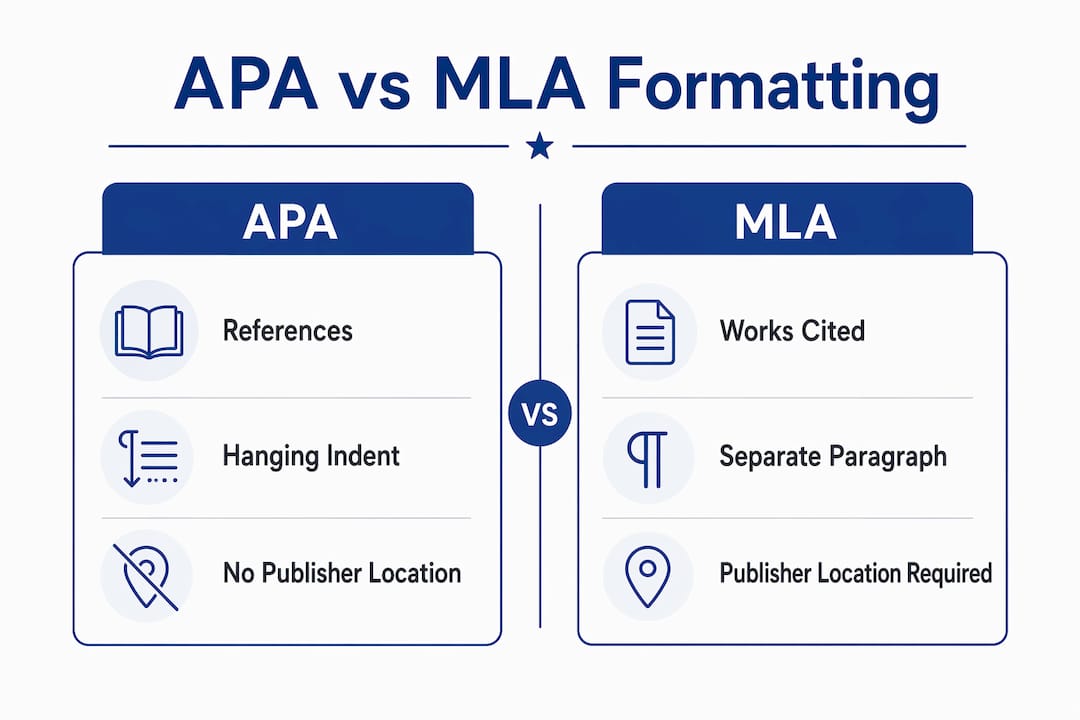
| Feature | APA (7th edition) | MLA (9th edition) |
|---|---|---|
| Page/section title | “References” (centered, bold) | “Works Cited” (centered, not bold) |
| Citation hanging indent | Yes — second and subsequent lines indented 0.5 in. | Yes — same rule applies |
| Annotation placement | Begins on the line directly below the citation, no extra indent | Begins on the line directly below the citation, no extra indent |
| Line spacing | Double-spaced throughout, including annotations | Double-spaced throughout, including annotations |
| Recommended annotation length | about 150 words (style guide does not specify; university guides recommend this as typical) | about 150 words (same practical guidance) |
| Author format | Last name, Initials. | Last Name, First Name (first author only) |
| Book title format | Italicized, sentence case | Italicized, title case |
The single most common layout error is applying the citation’s hanging indent to the annotation paragraph as well. The hanging indent belongs only to the citation line. The annotation itself starts flush with the left margin (or with the hanging-indent position, depending on your department’s template). University of Waterloo’s Writing and Communication Centre notes that a structured Word template is the most reliable fix for this confusion, since it automates the indent behavior rather than leaving it to manual tab stops.
APA 7th also dropped the publisher location requirement for books, a detail many students still include from older guides. MLA 9th, by contrast, still includes the publisher city only when it is needed to identify the edition. When in doubt, check the most recent edition of each style’s official manual.
How to write an annotation step by step
Writing a strong annotation is a four-step process. Follow it in order and you will avoid the most common grading failure: the summary-only annotation.
-
Read and annotate the source. Skim the abstract, introduction, and conclusion first. Then read selectively, marking the research question, methods, key findings, and any stated limitations. Note the author’s credentials and the publication venue.
-
Answer Engeldinger’s questions. These practical prompts force analysis beyond summary: Who wrote this, and what qualifies them? Who is the intended audience? What methods did the authors use? What are the main claims? What gaps or limitations does the source have?
-
Draft each annotation in three moves. Start with a one-to-two sentence summary of the source’s argument and methods. Add one to two sentences assessing the author’s authority, the source’s credibility, and its limitations. Close with one to two sentences explaining how you will use this source in your own project. That structure — summary, assessment, reflection — is what UNC Chapel Hill’s Writing Center identifies as the core of an effective annotation.
-
Write the citation first, then the annotation. Formatting the citation before you write the paragraph keeps you from forgetting details like volume numbers or DOIs. Once the citation is correct, the annotation flows naturally beneath it.
Pro Tip: Write the reflection sentence last and make it specific: “I will use this source’s 2019 survey data to support my claim in section three” is far more useful to a reader (and to your own drafting process) than “this source will be helpful for my paper.”
Sample annotated bibliographies: APA and MLA mini-examples
The two mini-bibliographies below show how multiple entries look together on a page.
APA mini-bibliography (3 entries)
References
Goldschneider, F. K., Waite, L. J., & Witsberger, C. (1986). Nonfamily living and the erosion of traditional family orientations among young adults. American Sociological Review, 51, 541–554. (Evaluative) The authors use nationally representative longitudinal data to show that independent living before marriage shifts gender-role attitudes, particularly among young women. The dataset is rigorous and the methodology transparent. Published in 1986, the findings predate major cultural shifts, so they serve best as a historical baseline for contemporary comparisons.
Morris, J. M. (1959). Reading in the primary school: An investigation into standards of reading and their association with primary school characteristics. Newnes for National Foundation for Educational Research. (Descriptive) Morris reports a large-scale study of reading standards across sixty schools and more than 8,000 students, examining how class size and teaching methods relate to reading outcomes. The study is historically significant for evidence-based reading instruction research.
Vowles, R. B. (1962). Psychology and drama: A selected checklist. Wisconsin Studies in Contemporary Literature, 3(1), 35–48. (Reflective) This checklist covers scholarship on psychology and drama from 1920 to 1961, organized by author. Its value is primarily bibliographic rather than argumentative. I will use it as a starting point for tracing the history of psychological approaches to dramatic texts in my literature review.
MLA mini-bibliography (3 entries)
Works Cited
Goldschneider, Frances K., et al. “Nonfamily Living and the Erosion of Traditional Family Orientations among Young Adults.” American Sociological Review, vol. 51, 1986, pp. 541–554. The authors draw on longitudinal survey data to argue that living independently before marriage weakens adherence to traditional gender roles, especially among women. The nationally representative sample strengthens the study’s credibility, though its 1986 publication date limits its applicability to current social contexts. This source will anchor the historical section of my argument about shifting family structures.
Howard, Ted, and Jeremy Rifkin. Who Should Play God? Dell, 1977. Howard and Rifkin document the political and ethical opposition to genetic engineering that emerged in the 1970s. The book’s ideological stance is explicit, which limits its use as a neutral source but makes it valuable for representing a specific political perspective. I will cite it when discussing left-leaning critiques of biotechnology in my introduction.
Vowles, Richard B. “Psychology and Drama: A Selected Checklist.” Wisconsin Studies in Contemporary Literature, vol. 3, no. 1, 1962, pp. 35–48. A reference checklist covering psychological approaches to drama from 1920 to 1961. Useful as a bibliographic tool rather than a theoretical argument; best consulted at the start of a literature search on this topic.
On organization: entries are alphabetical by author’s last name by default in both APA and MLA. Some instructors allow thematic grouping, where entries are clustered by subtopic and labeled with a subheading. Always confirm the preferred organization with your instructor before you finalize the document. University of Notre Dame’s library guides and similar resources show both formats with examples.
For a ready-formatted Word document with correct hanging indents and spacing already built in, Rivary’s APA-7 templates are set up so you can drop your citations and annotations straight into the correct layout.
Common mistakes and how to fix them before you submit
Most annotation errors fall into five categories. Here is what goes wrong and how to correct it quickly.
-
Summary-only annotations. You describe what the source says but never judge it. Fix: after your summary, add at least one sentence evaluating the author’s credentials or the study’s limitations, and one sentence on how you will use the source. University writing centers consistently flag this as the most common grading failure.
-
Wrong citation format. APA and MLA handle author names, titles, and publication details differently. Fix: format the citation first using the official style guide or a library guide, then write the annotation. Never rely on auto-generated citations from databases without checking them manually.
-
Wrong annotation type. You write a purely evaluative annotation when your instructor asked for descriptive only, or vice versa. Fix: confirm the annotation type in writing before you start. Cornell University Library recommends doing this before writing a single entry.
-
Incorrect indentation or spacing. The hanging indent is applied to the annotation paragraph instead of only the citation, or the document is single-spaced. Fix: use a Word template with the formatting already built in rather than applying manual tabs.
-
Weak or missing evaluation. You note a limitation but do not explain why it matters for your project. Fix: every evaluative sentence should connect back to your research question. “This source is from 1986” is weak. “This source predates the internet era, so its findings on information-seeking behavior do not apply to my study of social media use” is useful.
Instructor checklist before submitting:
- Annotation type confirmed with instructor (descriptive / evaluative / combination)?
- Citation formatted correctly in the required style (APA 7th or MLA 9th)?
- Annotation includes summary, assessment, and reflection?
- Annotation length matches the typical ~150 words recommended in university guides?
- Entries in alphabetical order by author’s last name (or thematic grouping if approved)?
- Hanging indent applied to citations only, not annotation paragraphs?
- Document double-spaced throughout?
Warning: AI tools can draft annotation text quickly, but they often produce summary-only paragraphs with no genuine evaluation. If you use AI assistance, add your own evaluative and reflective sentences and confirm with your instructor that AI-assisted drafting is permitted.
Key Takeaways
An annotated bibliography requires three elements in every entry: a correctly formatted citation, a summary of the source, and an evaluative paragraph that assesses credibility and explains how the source fits your project.
| Point | Details |
|---|---|
| Confirm annotation type first | Ask your instructor whether they want descriptive, evaluative, or combination annotations before writing anything. |
| Follow the three-part structure | Every annotation needs a summary, an assessment of the source’s authority and limits, and a reflection on how you will use it. |
| Apply formatting rules precisely | APA 7th and MLA 9th differ on author format, title case, and citation details; the hanging indent applies to citations only, not annotation paragraphs. |
| Target about 150 words per annotation | University guides consistently recommend this length as practical. |
| Use Rivary’s APA-7 templates | Rivary’s pre-formatted Word templates automate hanging indents and spacing so you can focus on writing, not layout. |
The part of annotated bibliographies most students overlook
Most students treat an annotated bibliography as a chore to finish before the real writing begins. That framing wastes the assignment’s actual value.
The annotation process, done properly, is where your argument takes shape. When you write the reflection sentence for each source — “I will use this to support claim X in section Y” — you are building a map of your paper before you draft a single paragraph. Gaps in that map become visible fast: if you have six sources supporting one claim and none supporting another, the bibliography tells you that before you are 3,000 words deep.
The Engeldinger questions are particularly useful here. Asking “what methods did the authors use?” and “who is the intended audience?” forces you to think about whether a source actually fits your argument or just sounds relevant. That distinction matters most during the literature-review stage, where the temptation to include every source you found is strongest.
Formatted templates speed this process considerably. When the layout is already correct, you spend your time on the intellectual work rather than fighting with Word’s indent settings. That is the practical reason Rivary’s templates exist: not to do the thinking for you, but to remove the friction that gets in the way of it.
Rivary’s APA-7 templates save you the formatting work
Writing strong annotations takes real intellectual effort. The layout should not be the hard part.
Rivary offers downloadable Word templates pre-formatted in APA-7, with correct hanging indents, double spacing, and annotation placement already built in. Drop your citations and annotation text into the template and the layout is done. For students who need a complete model to work from, Rivary’s sample academic papers include annotated bibliography sections formatted to APA-7 standards, available immediately after purchase. No waiting, no back-and-forth with a tutor. If you are starting a thesis and need the structure before the content, that is exactly what these resources are built for. Visit Rivary to download a template and get your bibliography formatted correctly from the first entry.
Useful sources for annotated bibliography guidance
The resources below are the most authoritative references for formatting rules, annotation-writing advice, and ready-made examples.
For formatting rules (APA and MLA citation format, spacing, indents):
- Purdue OWL (owl.purdue.edu) — the most widely used free reference for both APA and MLA formatting; includes sample annotated bibliographies in multiple styles and is a standard reference point for instructors.
- APA Citation Guide (7th Edition): Annotated Bibliography — University of Nevada, Reno library guide covering APA-specific annotation placement and citation formatting with sample entries.
- APA Publication Manual (7th edition) — the official source for all APA formatting rules; available in most university libraries.
- MLA Handbook (9th edition) — the official MLA style reference; consult it for current citation formats, especially for digital and multimedia sources.
For annotation-writing advice and examples:
- Cornell University Library: Annotated Bibliographies — clear guidance on annotation types and length, with examples.
- UNC Chapel Hill Writing Center: Annotated Bibliographies — strong on the evaluative component; explains why summary-only annotations fall short.
- University of Notre Dame LibGuides: Sample Annotations — multi-entry samples in both APA and MLA, useful for seeing how a complete bibliography is organized.
- Wartburg College (Vogel Library): Annotated Bibliography Examples — includes the Engeldinger framework for writing evaluative annotations.
- University of Waterloo Writing and Communication Centre — practical formatting guidance, especially on hanging indents and Word layout.
For ready-formatted templates:
- Rivary APA-7 templates and sample papers — downloadable Word documents with correct APA-7 formatting built in, including annotated bibliography layout.